Contributions to Free Software in 2025
Three years ago, I started working on wtr(1) (Work Time Recorder), a time tracking system that complies with my intolerance to toil but allows me to track the time spent on projects for work (as one would expect) and for fun (as one might not have expected). Time tracking happening without me having to think about it, I try to track all "major" projects or at least each "organization" I am involved in in my contributions to Free Software.
I now have 2 full years of metrics, and so can compare them and maybe learn a few things! First, let's see a fancy graph similar to the one produced by GitHub for my overall activity over 2024 and 2025:
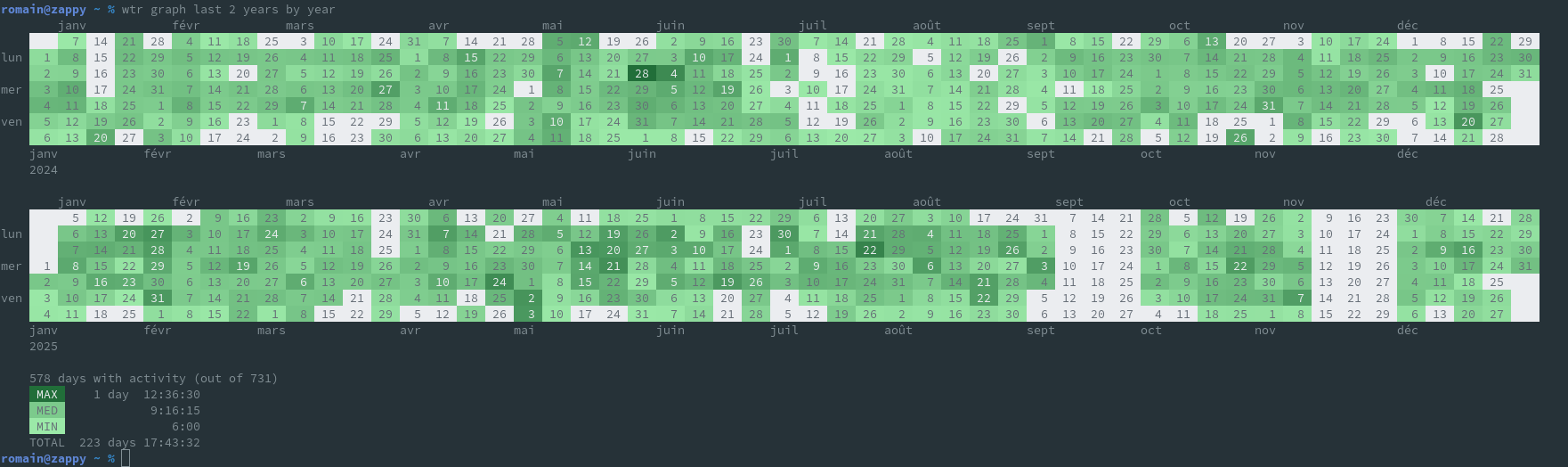
Beside showing obvious periods of vacations, this view provide a few interesting metrics:
- The number of days with/without activity recorded for the full date range (578/731);
- The median duration of activity recorded by day (9:16:15)
- The total duration of activity recorded for the full date range (223 days 17:43:32)
Call For Testers: Puppet 5 ports on FreeBSD
Lately, I have been working on bringing Pupept 5 to FreeBSD. For now, this effort is avialable through a set of ports on GitHub:
https://github.com/smortex/puppet5
The following article describes how I used this ports to update to Puppet 5. If you try to update, please tell me if you succeeded or failed, and how to improve this!
Disabling mouse feature from composite remote device
The remote of my Kodi based media center recently died and I bought a replacement one, identified as a 2.4GHz Fly Air Mouse Wireless Keyboard Motion Sensor Remote Control on Banggood.

The device is viewed as a composite one consisting of a keyboard and a mouse. The mouse feature can be disabled/enabled using a mouse lock button on the remote.
Only problem, when the device wakes up from standby mode, the mouse device is always enabled and the cursor moves on screen, selecting whatever is below it… Pressing the mouse lock button stops the madness, but as the mouse enter standby mode after a few seconds of inactivity the same problems happen over and over again.
I fixed this by software. This was a 2 steps process:
- Reduce the mouse sensitivity so that the cursor does not move when the device moves;
- Trigger keypresses on mouse clicks.
Patching screens EDID information
Quite a long time ago (September 2012), the x11/nvidia-driver port was updated to 304.43, which brought-in some major changes. The most noticeable one from my point of view was the inability to use my two Samsung SyncMaster BX2240 monitors at a resolution better than 800x600 (they have a native resolution of 1920x1080), providing a stunning 1600x600 desktop experience. With no time to dig-in this at that time, I reverted to the previous nvidia-driver and planned to have a look at it later.
I finally took the time to search for a solution. I post it here for two reasons: a) I might need this information at some point in the future and am more likely to find it that way and b) I might not be the only one here which faced this situation.
The first step was to modify my Xorg configuration to be a bit more verbose about the process of choosing a screen resolution when X starts to see if something was different with both drivers. This can be achieved by editing the Monitor section:
Section "Monitor"
    ...
    Option "ModeDebug" "TRUE"
EndSection
TeXLive 2012 on FreeBSD
Two months ago (August 2nd, 2012), I updated the freebsd-texlive project to provide TeXLive 2012 to the FreeBSD community.
More recently (October 1st, 2012), I made major changes in the freebsd-texlive project to fix the long-standing problem of TeXLive shipping distfiles with no version in the filename and replacing them in place. After setting up a new mirror with renamed distfiles (sponsored by NFrance, a French hosting company using the FreeBSD operating system. Many thanks to them for providing hosting and bandwidth!), updating the program that creates and updates ports, updating the updating tools, switching to the new mirror and updating all ~2250 ports; all the caveats around this choice from the maintainers of the TeXLive distribution should be gone!
This change will however not be without consequences for users. Distfiles version numbers where created by using the date at which a file appeared or where updated on the upstream mirrors, but because of the mirroring delays, the file mtime could be earlier by more than one day. As a consequence, a file updated on 17th May, 2012 could have version number 20120518 (getting the real package version number in the distfile is a PITA). Because having the version in the distfile filename require consistent dates, the new ports use the date from the upstream distfile mtime, and many ports had their version going backwards… PORTEPOCH have so been bumped, and port management tools will want to update all these ports which are in fact unchanged.
It's the first time such a bad situation happen in the freebsd-texlive repository. I hope this will be the last and apologies to users who will be worried with this massive update.
Happy TeXing!
Book Review: FreeBSD Device Drivers
Joseph Kong strikes again! When I saw Designing BSD Rootkits I was quite excited because:
- it was on some topics I had interests in but had not as much time as I would have liked to to dig in;
- it was focussed on my main operating system.
I bought the book and although it was rather small (~140 pages) enjoyed learning quite a large amount of things about the FreeBSD kernel.
So, when I was contacted by No Stash Press to know if I would be interested in a review copy of their upcoming book FreeBSD Device Drivers by the same author in exchange of writing what I though about it, I had no hesitation and accepted the deal.

Updating a ZFS Mirror
A few days ago, while I was on the phone, my machine experienced a kernel panic. The backtrace pointed a problem somewhere in the swap management code. I was on a hurry at that time and rebooted the machine without taking the time dig in the problem deeper.
On the next day, I eventually realised that an hard disk was logically missing on the system and the ZFS mirror it was belonging to was working in a degraded mode. This disk holding a swap partition, the panic quite makes sense: some data was stored there and could not be paged-out anymore.
# zpool list
NAME   SIZE  ALLOC   FREE    CAP  DEDUP  HEALTH  ALTROOT
data   294G  68,2G   226G    23%  1.25x  DEGRADED  -
tank  1,81T   300G  1,52T    16%  1.06x  ONLINE  -
# zpool status data
  pool: data
 state: DEGRADED
status: One or more devices could not be opened.  Sufficient replicas exist for
        the pool to continue functioning in a degraded state.
action: Attach the missing device and online it using 'zpool online'.
   see: http://www.sun.com/msg/ZFS-8000-2Q
  scan: none requested
config:

NAME                                            STATE     READ WRITE CKSUM
data                                            DEGRADED     0     0     0
  mirror-0                                      DEGRADED     0     0     0
    gptid/36711e52-a69e-11de-8adf-0018f38af467  ONLINE       0     0     0
    15152536002702365387                        UNAVAIL      0     0     0  was /dev/gptid/602da1ae-c474-11de-960d-0008a14dbca1

errors: No known data errors
Thomson ST2030 Feature Key Sheet Template
Technicolor's (ex. Thomson's) ST2030 SIP phone features 10 feature keys that can be used as fast call keys to reach a configured number by a single key-press.
![[ST2030 Feature Keys location]](https://romain.blogreen.org/images/st2030-feature-key.png)
Location of Feature Keys on the ST2030.
I finally decided to configure these keys with proper numbers instead of browsing my directory each time I want to make a call. But the phone only ships with a single paper sheet to hand-write the names corresponding to the configured numbers and my hand-writing is somewhat like what would produce a drunk cow with Creutzfeldt–Jakob disease. I browsed the Internet for a sheet template to fill-in, print and cut, but was unable to find some.
I'm on the Radio
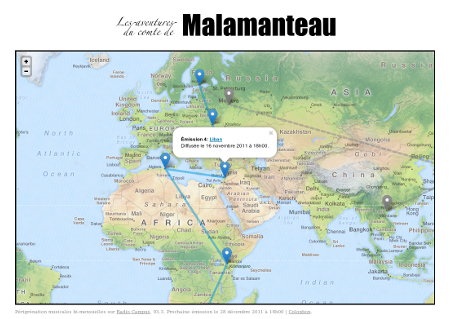
Earlier this year, 4 friends and I joined together with the goal of having our very own radio show. The first show was recorded in late November and was on air in the beginning of October. From that date, every two week, a new issue is broadcasted live on Radio Campus Clermont-Ferrand.
The show is called Les
aventures du comte de Malamanteau
(French for
Earl Malamanteau's Adventures), and is mostly music
centered: during one hour, a selection of music from a given
country (a different one for each issue) is aired. So far,
we have visited South Africa, Kenya, Tunisia, Lebanon,
Ukraine and Finland.
A website has been setup for listeners to have access to broadcasted shows and gathering more information about the music we chose and location we visited: malamanteau.fr.
TeXLive 2011 on FreeBSD
A few weeks ago, I updated the freebsd-texlive project to make TeXLive 2011 (the latest verison) available as ports for FreeBSD.
In order to help users who don't want to install the whole TeXLive collection (~2000 ports), a basic script has been developed to ease-up finding which port provides some file required by a given package.
As usual, feedback is welcomed!
![[RSS]](/images/rss.png)
